

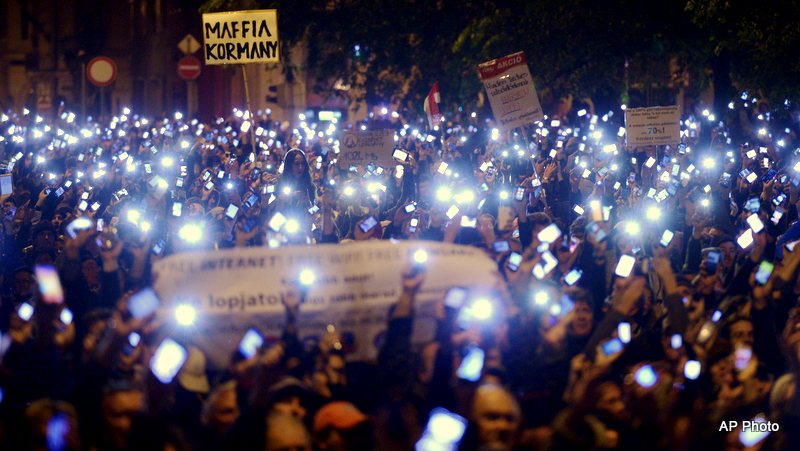
When the people in power try to make the internet more expensive and less free, one way for the public to respond is by gathering up all the obsolete computing equipment that’s lying around and start hurling it at government buildings.
That’s exactly what the people of Budapest did yesterday.
The world is struggling to figure out to future of the internet, which is why we’re constantly hearing about «net neutrality.» Basically, proponents of net neutrality think the internet should be free, equal, and accessible. That means internet service providers shouldn’t be allowed to create a tiered system that gives better service to those who can afford it, and worse service to people who can’t. ISPs would love to do just that.
For a better and funnier explanation of the issue, just watch John Oliver’s incredible rant:
In the United States, it’s the private ISPs that are trying to suck more money from their customers. In Hungary, it’s the government that’s trying to cash in.
It started last Tuesday, when Prime Minister Viktor Orban submitted his 2015 tax plan to parliament. In it was a very unwelcome surprise: A new tax that will charge 62 cents (USD) for every gigabyte of data transferred over the internet.
In some ways, the tax sounds worse than it is. The government said it would cap the tax at $2.88 per month, and service providers, not individuals, would be responsible for paying it.
But in other ways, the tax is an enormous deal. First off, service providers will pass the cost onto its customers, so this really is a tax on the people, not on corporations. Second, $2.88 doesn’t sound like a lot of money, but remember, this is the internet we’re talking about, and measures like this set precedents for the future. Third, it’s being levvied by a leader, Orban, and party, the Fidesz, that’s looking increasingly authoritatian.
That’s why thousands of Hungarians got together Sunday night at the economic ministry building and the Fidesz party headquarters in Budapest — and did this.